


“Intelligent automation of SME loan underwriting”
Automating SME underwriting can bring four main benefits:
- much higher loan volumes without more staff;
- lower operating costs;
- higher portfolio profit;
- the same underwriting quality on every loan.
This case study shows how a major North American SME lender achieved them with Zoral Decision Engine and the Zoral model library.
The client and the problem
The client is a major North American SME finance company. It wanted to grow its SME loan book and its market share substantially.
Its underwriting was sophisticated and effective, but traditional, manual and hard to scale. SME underwriting needs deep analytical skill and experience, so results varied from one underwriter to the next. The work ran on loosely connected systems, with manual data capture and partly manual workflows.
As volumes grew, loans took longer to process, and decision quality and consistency began to slip. The lender hired more underwriters, but portfolio results got worse. Underwriting had become the bottleneck, and it needed to be automated.
What the lender needed
- Automate underwriting with a mix of people and machine intelligence.
- Cut operating costs while it grew.
- Automate and strengthen risk-based pricing and portfolio management.
- Improve data quality, make better use of existing data and add new sources.
- Make better underwriting decisions and accept more good loans.
- Reduce loan-loss provisions and control them better.
- Add more digital products.
It chose robo-underwriting with Zoral Decision Engine and the Zoral model library. This also helped it move more products from offline to digital.
How the work was done
The work used standard Zoral Decision Engine and model-library products, starting with a short proof of value. It covered integration with the lender’s systems and data providers, go-live, handover and training.
Zoral Decision Engine was connected to:
- SME application and document data;
- the lender’s CRM and deal rooms;
- its core banking, finance and loan management systems;
- open-banking and bank-statement data providers;
- several credit bureaus;
- external databases of company information over time;
- government and third-party company verification services;
- public company information, such as the company’s website and listings.
The robo-underwriter workflow was tuned on SME data that was enriched automatically. A range of standard models from the Zoral model library was used.
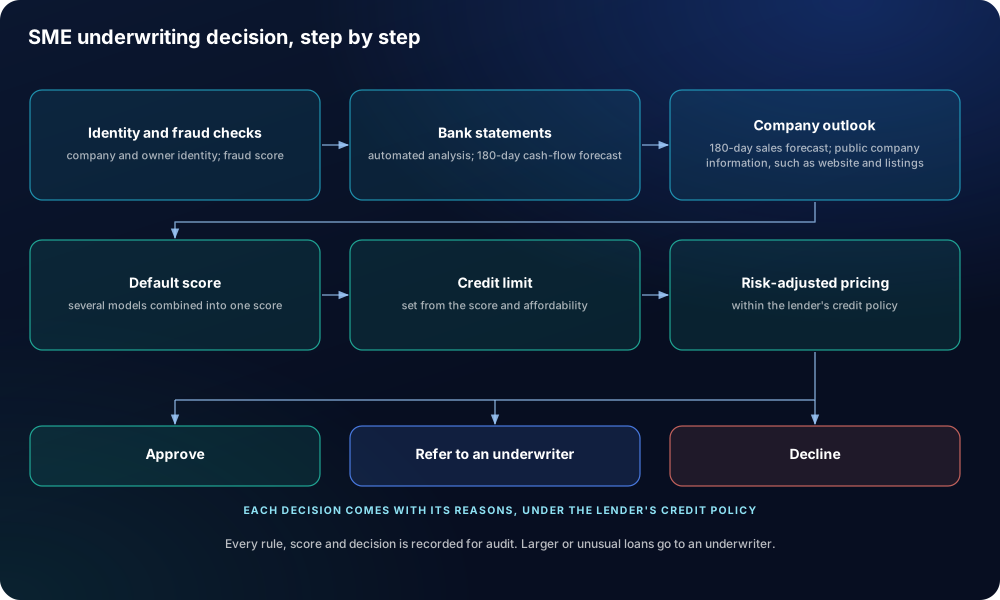
How the website or app asks Zoral Decision Engine for a robo-underwriter decision
Predicting default and write-off
The default model from the Zoral model library predicted write-offs automatically.
Default score’s ability to rank SME loans by probability of write-off
Note: each segment represents 10% of the SME portfolio.
At first, only the lender’s existing data was used, to compare its internal underwriting score with the Zoral default score. Additional data sources were then added, and accuracy improved at once.
Zoral default score vs the company’s internal underwriting score
Note: The Zoral model showed more predictive power than the lender’s own model, for three main reasons: (1) Zoral Data Fabric brought in a far wider range of data. Hundreds of data points were used, against fewer than 30 inputs in the lender’s existing models, which people had tuned by hand. (2) Zoral Decision Engine used several non-linear models together, against the lender’s traditional linear model. (3) The Zoral model library carried long research and global experience.
Public company information, such as the company’s website and listings, further improved write-off prediction.
Using public company information to improve write-off prediction
Underwriter performance
Next, the lender’s underwriting team was analysed with the same default models.
Sample underwriters performance
Note: A representative sample of underwriters over the latest year is shown. The blue line shows the average default rate of the SME loans each underwriter approved. All the underwriters used the same policies and approval procedures, yet their default and write-off rates (in red) varied widely.
The best underwriters performed well, but performance across the team was not consistent.
Sample underwriters KPIs
Note: Underwriter #6, who mostly reviewed SME loans of $20,000–$50,000, approved 54 loans a month on average. Underwriter #5, the least productive and very experienced, approved 39 a month on similar loans, but with a much lower write-off rate.
Write-offs also varied for another reason. Each underwriter started from the internal score. Each then added their own judgement on the five Cs of credit: character, capacity, capital, collateral and conditions. Over a year, the team’s risk grades were compared with grades based on the Zoral default score. The comparison showed a further loss of performance.
Zoral default score vs underwriters’ classification
Overall, write-offs and profit were acceptable for a business that was not growing. But they could not support the growth the lender was seeing and planning. Put simply, its underwriting could not scale quickly or safely. More decisions needed to be automated, using a wider range of customer and third-party data.
Next steps
More models and automated SME checks were added, and their results fed the robo-underwriter in Zoral Decision Engine. Its decisions were passed through the engine to the lender’s existing systems, from the arrival of a lead to approval and loan payout. The results:
- the best underwriters made even better decisions;
- weaker underwriters improved;
- the team handled much larger volumes;
- portfolio results improved;
- less money and time went on leads that did not close or performed poorly;
- the lender met its goals for scaling underwriting;
- 95% of loans under $50,000 were underwritten automatically;
- risk-based pricing and terms were applied consistently;
- underwriters were freed to focus on larger and unusual loans, and on new products.
Most of the SME book moved to automated decisions under the lender’s own credit policy, with machine-learning models its credit team approved.
Highlight
- 95% of loans under $50,000 underwritten automatically
Sample underwriters’ KPIs before and after automation
With the robo-underwriter, the SME write-off rate fell. Write-off rates varied far less between underwriters (shown in grey), and the weaker underwriters improved while handling more loans each month.
Results
- Profit up 27%
- Portfolio write-offs down 68%
- Yearly volume growth up 123%
- Manual underwriting down 70%
- Acceptance rate up 16%
- 95% of underwriting decisions for SME loans under $50,000 automated
Variation in underwriter performance fell.


 +44 20 3963 2002