
Business Outcomes Layer

See what every change does to your business results

The Business Outcomes Layer is how the Zoral Finance Operating System (fOS) measures results against plan, by product and channel. It shows where and why results drift. Most platforms report tasks completed. The Business Outcomes Layer reports business results.

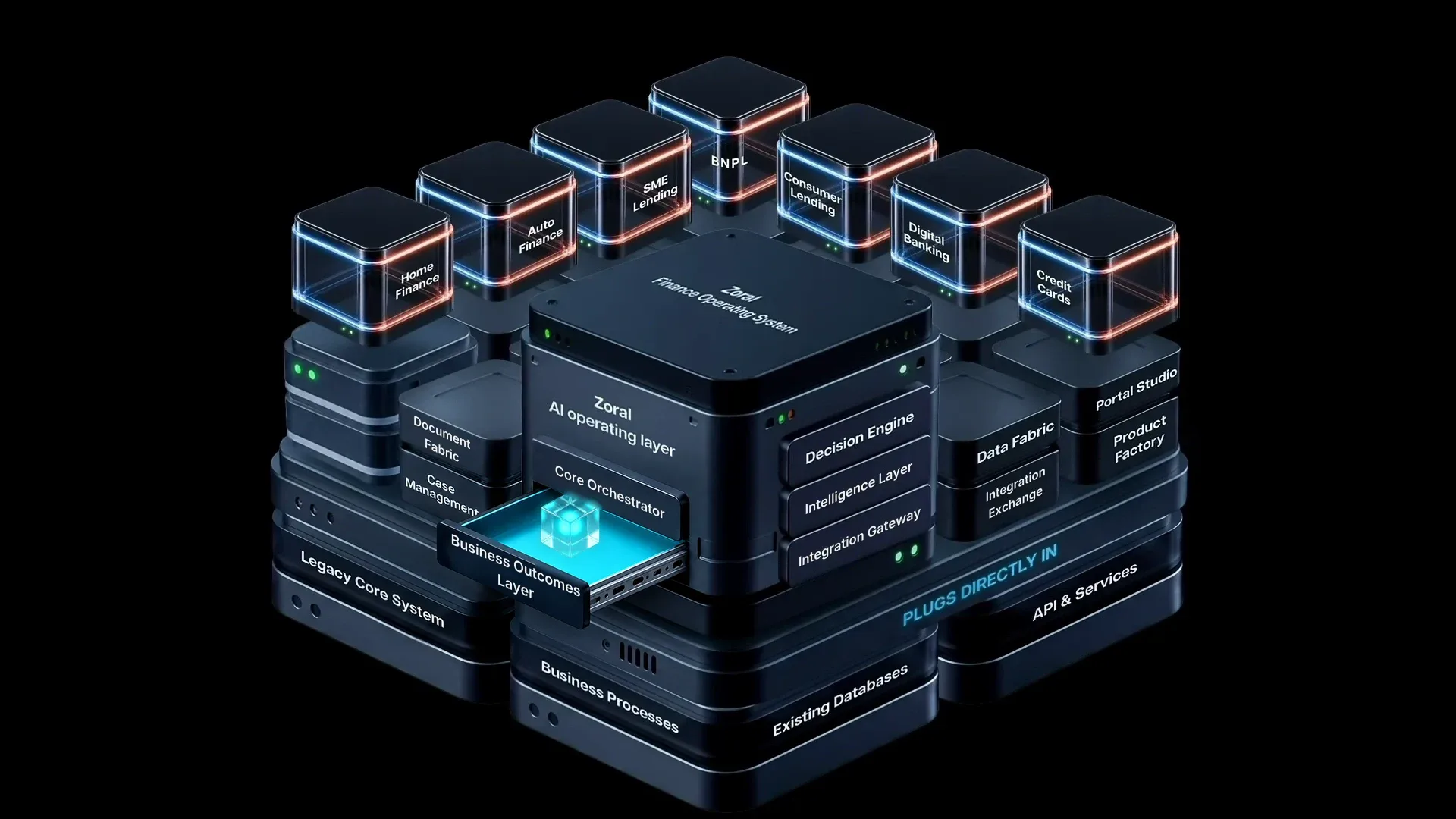
The Zoral fOS stack with the Business Outcomes Layer module highlighted

Risk, cost and revenue, tracked together

Many banking systems keep risk apart from operations. A credit model can look excellent and still lose money through costs no one tracks.

A low default rate is no use if acquisition and data costs eat the margin, or if customers leave before they become profitable.

The Business Outcomes Layer sits at the centre of Zoral fOS. Zoral Data Fabric remembers every application, decision and change. Zoral Decision Engine decides, applying your credit policy. The Business Outcomes Layer measures what those decisions do to the business.

The numbers behind unit economics

From portfolio targets, such as return on equity, to credit, cost and retention.

  • Growth and acquisition

    Acquisition cost, loan volumes and average loan size.

  • Risk and pricing

    Risk-based pricing, terms, default rates and diversification.

  • Data and AI costs

    Bureau, verification and AI costs, per application.

  • Operations

    Middle- and back-office effort and operating cost.

  • Retention and lifetime value

    Retention, term, early repayment, refinancing and lifetime value.

  • Capital and collections

    Capital used, fees, and collection and recovery rates.

What the Business Outcomes Layer does

Unit economics, tracked as results come in

  • Links each business goal to the decisions and workflows behind it.
  • Shows how small rises in operating, data or acquisition costs reduce the margin.
  • Tracks retention against plan, so customer losses show early.
01 / 05

Where banks and lenders use it

  • Lending profitability

    Links underwriting results to profit, and balances growth against each product’s capital limits.

  • New product forecasts

    Simulates revenue, cost and risk before a new product launches.

  • Operations

    Shows what each process improvement does to operating cost and acceptance rates.

  • Collections

    Tracks recovery rates alongside customer experience and the contact rules your team sets.

  • Model monitoring

    Compares actual defaults with forecasts, and shows when they drift apart. Your model risk team can then review the model.

Compared with stand-alone simulation tools

Stand-alone simulation tools test changes in a separate environment. Someone then has to recode the change in another system. The Business Outcomes Layer measures, tests and releases on one platform.

  • Scope

    Stand-alone simulation tools

    Usually credit rules and risk models

    Business Outcomes Layer

    Risk, marketing, operations, data and AI costs, retention

    What it means for the bank

    Lost margin shows up early

  • Data

    Stand-alone simulation tools

    Often historical samples

    Business Outcomes Layer

    Live results and past applications

    What it means for the bank

    Cause and effect as results come in

  • From analysis to release

    Stand-alone simulation tools

    Reports, then recoding elsewhere

    Business Outcomes Layer

    Analysis, approval and release in one place

    What it means for the bank

    No recoding

  • Governance

    Stand-alone simulation tools

    Often outside the bank’s change control

    Business Outcomes Layer

    Tested, approved by a second person, recorded

    What it means for the bank

    Only approved changes reach customers

  • Forecasting

    Stand-alone simulation tools

    Often revenue, without detailed costs

    Business Outcomes Layer

    Full unit economics, simulated on past portfolios

    What it means for the bank

    Forecasts your finance team can check

For your architects

  • Data

    It works on Zoral Data Fabric, which records every application, decision, change and cost event, with the rule and model versions used. Cost and finance data from other systems arrives by API, events or files (REST, Kafka, RabbitMQ).

  • Simulation

    Past applications are run through the proposed rules and models in Zoral Decision Engine, outside production, and compared with the live version.

  • Release

    Approved changes follow the same versioning, test environment and release steps as all Zoral fOS configuration. Each release is tagged, so its effect can be measured.

  • Your own tools

    Data can flow to your data lake or warehouse (for example Databricks or Google Cloud BigQuery) and your reporting tools.

  • Hosting

    AWS or Azure in your chosen region, or your own data centre.

In live lending

References are available in confidence.

A commercial banking group

The Challenge

Senior management could not see which change programmes improved product margins.

The Solution

The Business Outcomes Layer linked each digital lending change to product unit economics, across several business lines.

The Strategic Outcome

Senior management now directs investment to the changes that pay back.
A global lender

The Challenge

The lender could not predict how changing its credit score cut-offs would affect defaults, acceptance and volumes.

The Solution

Its risk team tested changes to cut-offs, limits, terms and pricing on past applications.

The Strategic Outcome

The lender launched the changes with evidence. It reduced its risk exposure while accepting more customers.

Questions banks ask

How do you stop unchecked changes to credit policy?

Rule, limit and model changes reach customers only after a second person approves them. Each change is first tested on past applications, so its effect is known before sign-off. Every step is recorded, and any change can be reversed.

Our data sits in separate systems. Do we need a data warehouse project first?

You do not need to finish one first. The Business Outcomes Layer connects to your existing data through secure interfaces. Zoral fOS records each application, decision and cost as it happens.

What does it need from our core banking system?

Very little. It works alongside your core through documented interfaces. Your core does not need to be changed or replaced.

How does it handle costs that arrive monthly?

It uses agreed baselines until the actual figures come in. Your view of unit economics stays useful between updates.

Couldn’t we build this with our own reporting tools?

Your reporting tools can show results. The harder part is linking each result to the rule, price or process step that caused it, and then changing that step safely. Without that link, each finding joins the growing backlog of IT projects. In Zoral fOS, the result, the change and its approval are on one platform. Your analysts can still use their own tools on the same data.

Who implements it?

Atelier, Zoral’s senior consulting practice. Its credit and customer-lifecycle specialists agree the measures with you and set up the baselines. Zoral can run and support the platform for you, your own technology team can run it, or we share the work and hand over as your team grows. Your people run the banking operations.

Customer lifecycle and collections · Credit risk and decisioning · Assessment and strategy

Cover of the Business Outcomes Layer product brief

Product brief

Get the Business Outcomes Layer product brief

9 pages to read and share with your colleagues: what it changes, how it is controlled and audited, and how it works with the tools you already own.

Download the product brief (PDF)

Run the portfolio on business results

Many banks still manage risk and return from monthly summary reports. The Business Outcomes Layer ties every product setting, credit rule and process change to the P&L and the balance sheet. Your leaders can act sooner, on evidence.

Contact Us

Prefer to pick a time? Schedule a meeting

Automate lending, banking and finance operations.

London

Epworth House25 City RoadLondonEC1Y 1AAUnited Kingdom
+44 20 3963 2002

Miami

1221 Brickell Building, Suite 900Miami, FL 33131USA
+1 (305) 347-5133