Zoral Resilient RPA

Automate the portals and old systems you cannot connect to

Many warehouse-bank portals, investor portals and green-screen cores offer no way to connect. Zoral Resilient RPA, part of the Zoral Finance Operating System (fOS), reads and enters the data on screen, so your staff do not retype it. When a screen changes, it finds the moved field, or stops and asks a person.

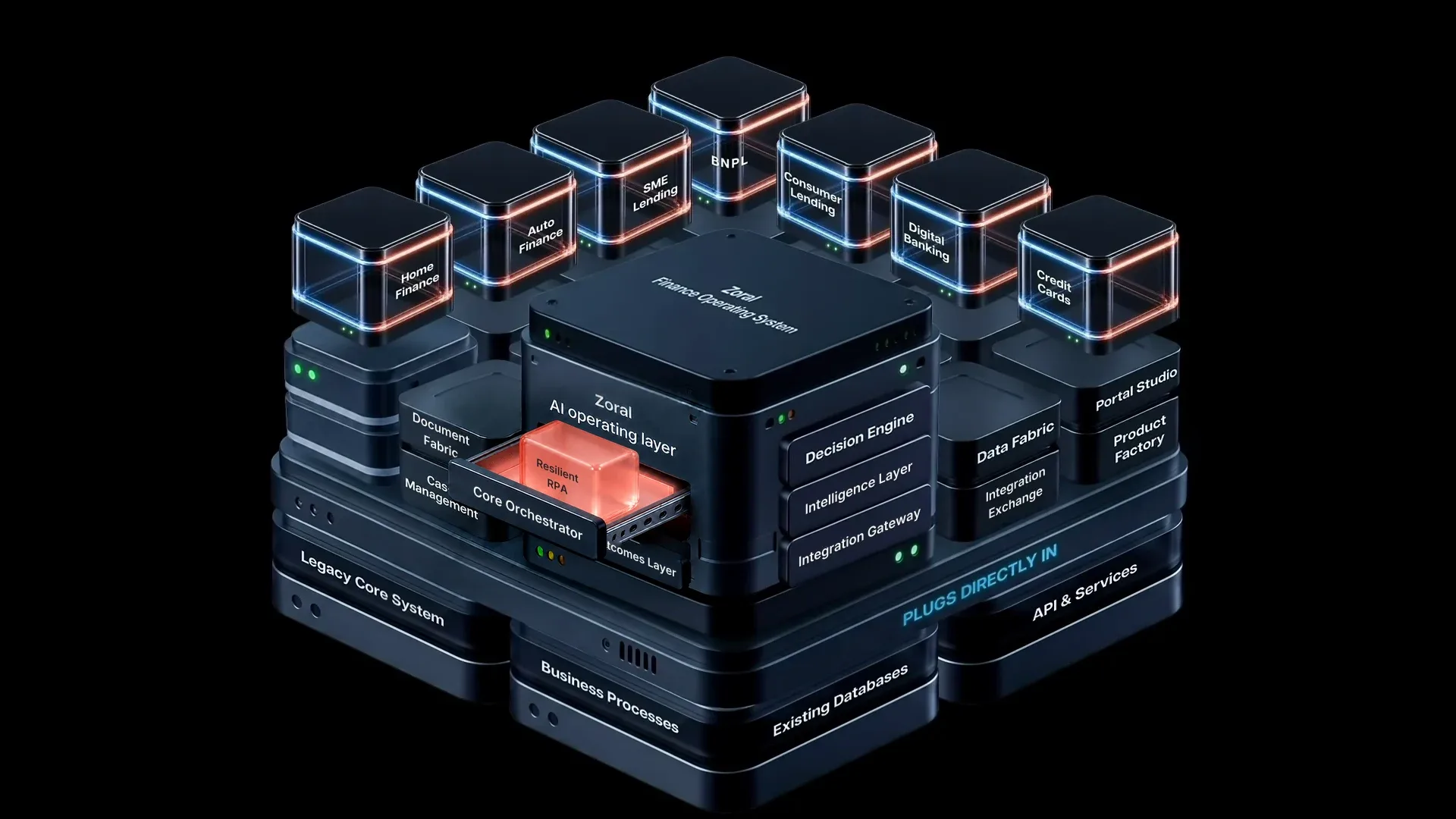
The Zoral fOS stack with the Resilient RPA module highlighted

Automation that keeps working when screens change

Many traditional bots depend on the exact layout of each screen. When a portal moves a field, the bot can stop or type into the wrong box. Engineers then fix it by hand.

Zoral Resilient RPA works around the centre of Zoral fOS. Zoral Core Orchestrator starts each run as a step in your workflow. Zoral Document Fabric, our intelligent document processing (IDP) service, integrated with Zoral fOS, reads the documents. Every step goes into the same audit trail as the rest of the process.

What changes for your operations team

  • Fewer broken bots

    When a field moves, an AI model finds its new position, checks it and adjusts the run. Engineers fix fewer bots by hand.

  • Stops when unsure

    If a screen changes completely or a field disappears, the run stops. A person checks before anything is entered.

  • Less retyping

    Data moves between systems without staff retyping it, in lending, onboarding, closing, post-closing and quality checks.

For your architects: how it works

Screen-change detection

A vision model tuned for business screens compares each screen with its last known layout. It identifies what has moved.

01 / 06

Traditional RPA and Zoral Resilient RPA compared

  • When a screen changes

    Traditional RPA tools

    Scripts often fail when a screen element moves, even slightly.

    Zoral Resilient RPA

    Finds the moved field and adjusts. If unsure, it stops and asks a person.

  • Maintenance

    Traditional RPA tools

    Engineers often fix scripts by hand after each portal update.

    Zoral Resilient RPA

    Layout changes are handled during the run. People review the uncertain ones.

  • What you run

    Traditional RPA tools

    Usually a separate bot platform, with its own tools and servers.

    Zoral Resilient RPA

    Runs inside Zoral fOS, driven by Zoral Core Orchestrator, which connects it to the other components. There is no separate bot platform to manage.

  • Audit

    Traditional RPA tools

    Bot logs usually sit apart from the banking record. Teams match them by hand.

    Zoral Resilient RPA

    Every step and adjustment goes into the same Zoral fOS audit trail as the rest of the process.

What Zoral Resilient RPA does for banks

  • Opening customer accounts

    Checks customer details on external sites your bank approves, and enters them in your own systems.

  • Processing loan applications

    Copies details from online application forms into back-office underwriting systems.

  • Matching balances and payments

    Checks daily banking spreadsheets against payment networks and flags mismatches for staff.

  • Shipping and import documents

    Collects tracking numbers and contract details from external portals, and sends them to the right team.

  • Account alerts

    When a payment is late, it can block a card or send a text message, following your bank’s rules.

Case studies

References are available in confidence.

Mortgage warehouse funding for a US mortgage lender

The client

  • Type

    An independent mortgage lender in many US states.

  • Volume

    Funds loans every day through several warehouse bank facilities.

The challenge

Funders typed wire details into each warehouse bank’s portal every day. The portals often changed, and standard bots stopped. Investors sent purchase advices as PDFs or images, which staff retyped and reconciled by hand.

What the lender did

Zoral Document Fabric reads each purchase advice, does the calculations and scores its confidence. Zoral Core Orchestrator then starts Zoral Resilient RPA to submit the checked data to each portal. When one bank moved its wire reference field to a new sub-menu, the run found it and carried on.

The results

Fewer calculation errors, and each loan placed on the lowest-cost line. Several portal changes were handled without developer fixes. The funding desk can take on higher volumes without adding staff.
A multi-product regional lender

The client

  • Type

    A regional lender serving consumers and businesses.

  • Systems

    Modern front-end platforms connected to green-screen core systems that are decades old.

The challenge

Security patches kept changing screen layouts, and the existing RPA scripts failed. Engineers left product work to fix them, and branch staff waited.

What the lender did

It moved these processes to Zoral Resilient RPA. Each run now checks the screens and adjusts positions within the approved process.

The results

Layout changes stop live work far less often. The engineers who supported bots moved to customer-facing work. Screen changes now follow a recorded process, not quick fixes in production.

Questions from risk, audit and technology leaders

AI in Zoral fOS is guardrailed, with human-in-the-loop supervision. The vision model acts only through the permissions, workflows and approvals your bank sets, and every adjustment is recorded. It does not make credit decisions, and accountability stays with your bank.

Does “self-healing” mean AI rewrites our code in production?

No. The process steps stay locked under your normal change control. The model changes only where the bot looks for each field on the screen. It does not change what the process does.

How do you stop the AI entering bad data into our systems?

Your team sets a confidence threshold for every adjustment. Below it, the run stops at that transaction. A person is alerted in the control room to check it.

Are our screens sent to a public cloud model?

Only to a model your bank approves. Screens are read by a vision language model that your bank configures and guardrails, within the environments and agreements you control. It can read a test account that runs the same software version, or a copy of the screen with the data removed, so it sees only where the fields are, not customer data. Zoral Core Orchestrator runs these steps inside the workflow.

How do we defend these runs in an audit?

Each adjustment is recorded in the Zoral fOS audit trail. The record shows the screen before and after, with any customer data blurred or masked first, the change made and the confidence score. Your risk team and examiners can trace every transaction.

We already use an RPA platform such as UiPath. Can we keep it?

Yes. Zoral fOS works with it, and Zoral Core Orchestrator can start your existing bots as steps in a workflow. Their logs sit outside the loan’s audit trail, though. So use Zoral Resilient RPA where screens change often, or where a step is part of a loan and must be traceable with it, such as mortgage processing and reconciliations.

Some banks add engineers to keep old bots running. That takes their time every time a portal changes, and the bot logs still sit apart from the loan record.

Who implements it?

Atelier, Zoral’s senior consulting practice, leads the work with your operations and technology teams. The people who built the platform are part of every programme. See Engineering and delivery and Data, AI & Automation.

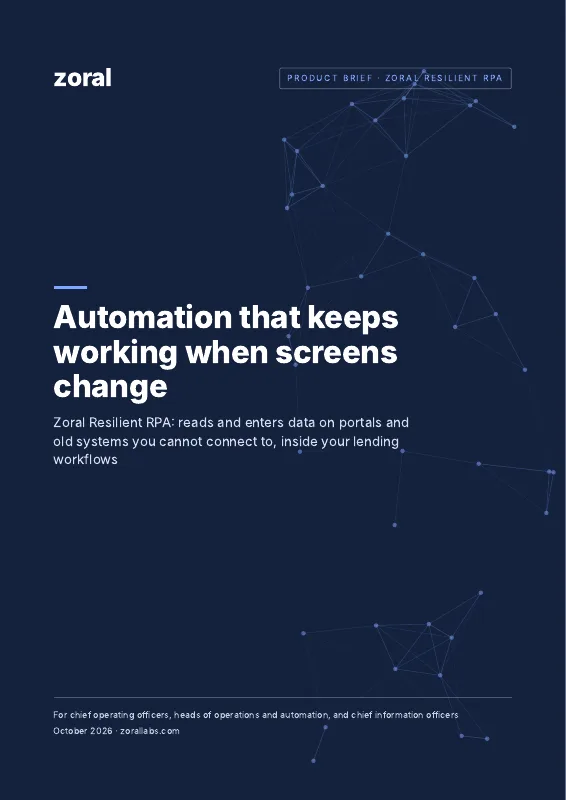
Cover of the Zoral Resilient RPA product brief

Product brief

Get the Zoral Resilient RPA product brief

9 pages to read and share with your colleagues: what it changes, how it is controlled and audited, and how it works with the tools you already own.

Download the product brief (PDF)

Which screens do your teams still type into by hand?

Show us the portals and old systems your staff work around today. We will show how Zoral Resilient RPA would handle them inside your workflows, with every step recorded.

Contact Us

Prefer to pick a time? Schedule a meeting

Automate lending, banking and finance operations.

London

Epworth House25 City RoadLondonEC1Y 1AAUnited Kingdom
+44 20 3963 2002

Miami

1221 Brickell Building, Suite 900Miami, FL 33131USA
+1 (305) 347-5133