


Why banks automate
Banks automate for a short list of reasons. They want to grow without costs rising at the same pace. They want a faster “yes” for good customers, and money to the customer sooner. They want fewer errors from re-keying, and better data. And they need to respond quickly when regulators or competitors move.
Why separate tools fall short
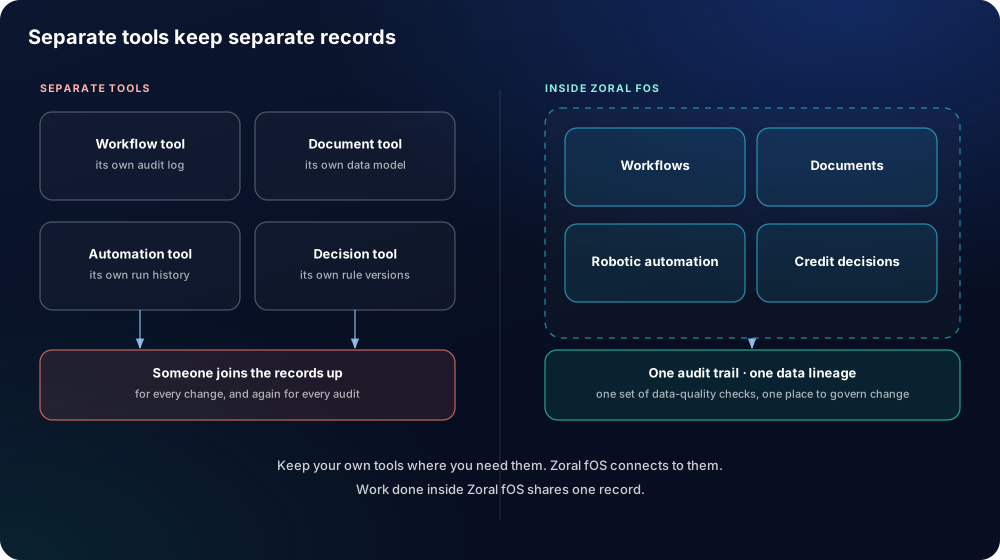
The usual answer is to buy separate tools: one for workflow, one for documents, one for robotic automation, one for credit decisions. Each tool may be good on its own. But each comes with its own contract, its own roadmap and its own data model. Every change to a product then touches several of them, and the backlog of IT projects grows.
You can fit any stereo you like to a car. But you would not build a car from one maker’s front axle and another maker’s rear axle. The parts that carry the load need to be designed together.
One centre
Zoral fOS has one centre. Zoral Data Fabric remembers every application, decision and change. Zoral Decision Engine makes every decision. The Business Outcomes Layer measures every result against plan.
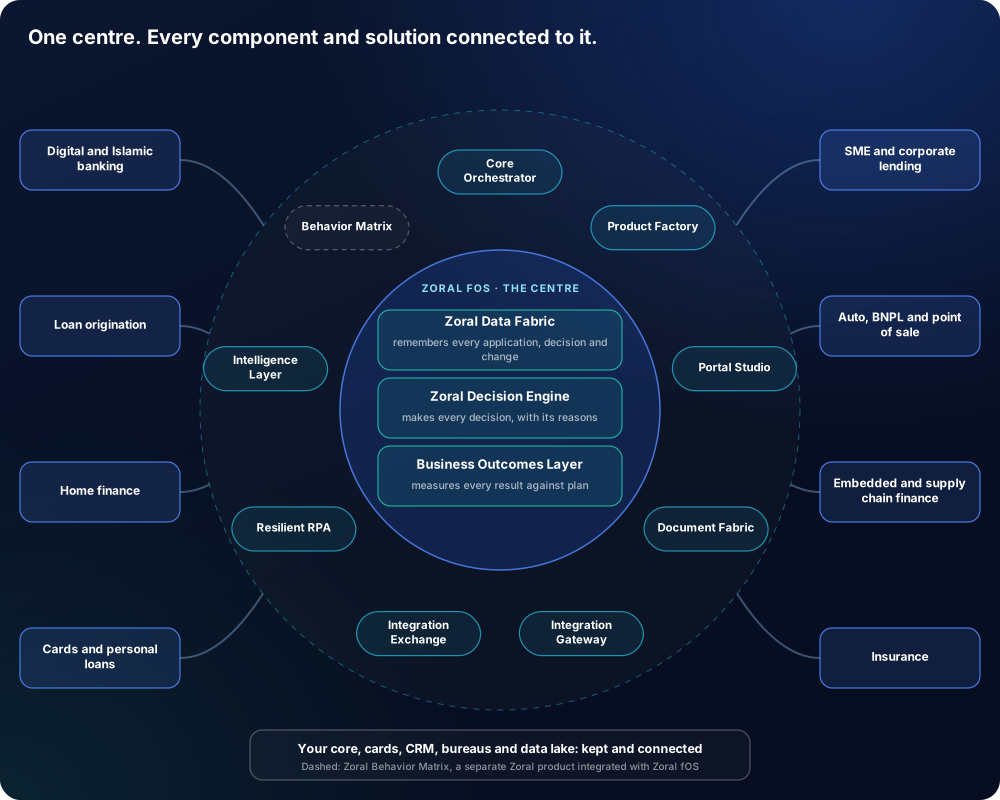
Around that centre, the other components do the work:
| Component | What it does for the bank |
|---|---|
| Zoral Core Orchestrator | Runs workflows and work queues, for people and AI agents |
| Zoral Product Factory | Defines products and accounts your teams can change |
| Zoral Portal Studio | Builds screens for customers, staff and partners |
| Zoral Document Fabric | Our intelligent document processing (IDP) service, integrated with Zoral fOS. Reads and checks documents, and passes the data on |
| Zoral Integration Gateway | Connects your core and other systems, both ways |
| Zoral Integration Exchange | A marketplace of ready connectors to partner services. Your bank contracts with each provider directly |
| Zoral Intelligence Layer | Governed AI and the model library |
| Zoral Resilient RPA | Works on portals and old systems that have no interface |
Zoral Behavior Matrix, a separate Zoral product, integrates with Zoral fOS. Where regulation and customer consent allow, it adds behavioural signals for fraud checks, fewer abandoned applications and personalisation.
Every Zoral solution reaches out from the centre into a product or a channel: loans, cards, home finance, SME, auto, point of sale, digital and Islamic banking, and insurance. Each draws on the same data, rules and measurement. So each new product costs less to launch, and starts smarter, than the last. Start with one product. Add the next on the same platform.
Your teams change it, safely
Your product, credit and operations teams change rules, products, screens and workflows themselves. Every change is versioned and tested on past applications or in a test environment. A second person approves it, and it can be reversed.
Open to your engineers
Where configuration ends, your engineers can:
- write React components;
- use their own Java, C# or Python libraries;
- connect any approved system;
- use their own machine-learning platform, such as Amazon SageMaker, Databricks or Google Cloud Vertex AI.
The bank’s own AI agents can use Zoral fOS through a standard interface (MCP). Your engineers’ changes are versioned and approved like everything else. Let your IT team be the architect, not only the builder.
Best of breed, built in. Or keep your own.
Each component is built to be among the best at its job in banking. Where you already own a tool that works, Zoral fOS connects to it. One point to weigh: work done inside Zoral fOS shares one audit trail, one data lineage from source to decision and one set of data-quality checks. Each separate tool keeps its own records, and someone has to join them up for the auditor.
AI, under your control
AI agents prepare, check and draft, under human supervision. They act only through the permissions, workflows and approvals your bank sets. Every action, prompt and tool call is recorded. Agents do not make credit decisions. Those follow rules and models your bank approves, and accountability stays with the bank. Machine-learning models handle default, pricing and limits. Language models read documents and draft. Your bank chooses its language models, connected through a standard interface (MCP).
Where it runs, and who runs it
Zoral fOS runs on AWS or Azure in your chosen region, or in your own data centre. Zoral can run and support the platform for you, your own technology team can run it, or we share the work and hand over as your team grows. Atelier, Zoral’s senior consulting practice, leads delivery with your teams.


 +44 20 3963 2002